
Digital marketing strategies play a critical role in driving e-commerce business growth by leveraging data, personalization, and multi-channel engagement.
In 2026, digital marketing strategies for ecommerce AI-powered automation and omnichannel marketing dominate the digital landscape, significantly improving conversion rates, customer experience, and brand loyalty.
This blog outlines a proven, SEO-friendly digital marketing framework for e-commerce businesses designed to deliver sustainable revenue growth.
Digital Marketing Strategies for E-commerce
1. Search Engine Optimization (SEO) for E-commerce
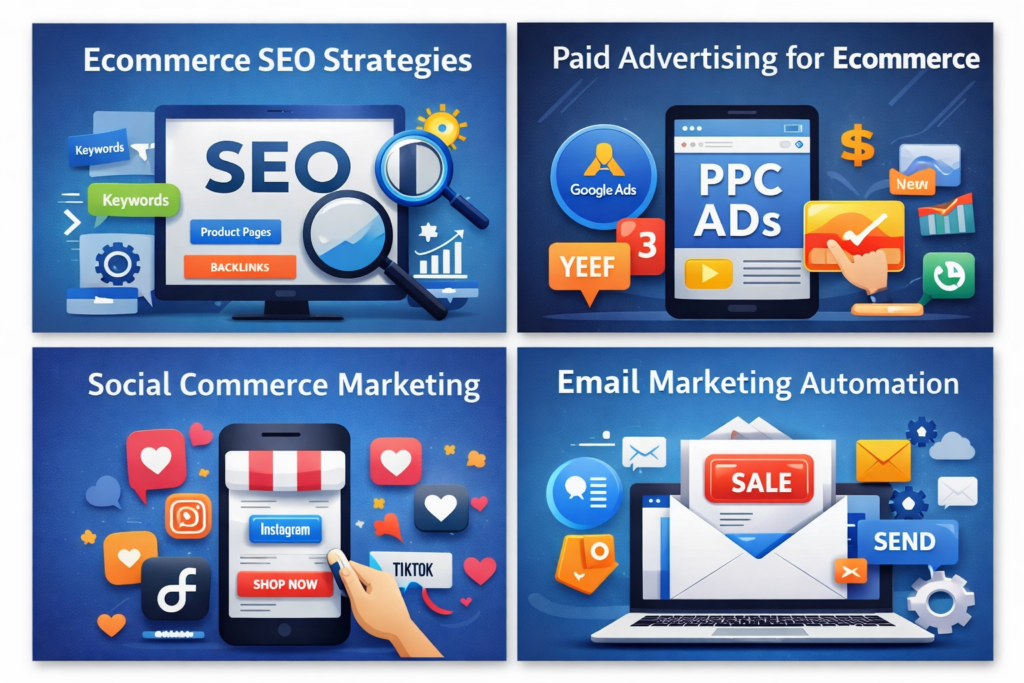
SEO remains the foundation of e-commerce success, helping brands capture high-intent buyers through organic search.
Best SEO practices for e-commerce websites:
- Target product-focused, category, and long-tail keywords
- Use tools like Semrush and Google Keyword Planner
- Optimize product pages with:
- Detailed product descriptions
- SEO-friendly meta titles & meta descriptions
- Internal linking between categories and products
- Ensure mobile responsiveness and fast loading speed
- Implement schema markup for rich results
📌 SEO builds long-term organic traffic and reduces dependency on paid ads
2. Content Marketing That Converts
Content marketing strengthens SEO while educating and nurturing potential buyers.
High-performing e-commerce content includes:
- 📝 SEO blogs and buying guides
- 🎥 Product demo videos and explainer videos
- 🤖 AI-generated landing pages with shoppable content
- ⭐ Customer reviews and user-generated content (UGC)
💡 Well-structured content improves authority, trust, and conversions.
💰 Paid Advertising & Performance Marketing
📊 3. PPC Advertising for Scalable Growth
Paid advertising delivers immediate results when executed strategically.
Key PPC strategies for e-commerce:
- Google Ads Smart Shopping & Performance Max
- Target ROAS bidding for profitability
- Use negative keywords to eliminate irrelevant traffic
- Run dynamic remarketing ads to recover abandoned carts
- Target high-intent keywords like:
- buy online
- best price
- free shipping
🎯 Paid ads accelerate growth and provide predictable sales volume.
📱 Social Media & Influencer Marketing
📣 4. Social Media Marketing for E-commerce
Social commerce is one of the fastest-growing sales channels in 2026.
Top-performing platforms:
- Facebook Shops
- Instagram Shopping
- TikTok Shop
- Pinterest (for product discovery)
Effective social media tactics:
- Shoppable posts and short-form video content
- Reels for product demos and brand storytelling
- Community engagement through comments and DMs
- Paid social ads for precise demographic targeting
🤝 5. Influencer Marketing for Trust & Reach
Micro-influencers deliver higher engagement and authentic brand trust.
Benefits of influencer partnerships:
- Real social proof
- Higher conversion rates
- Reusable content for ads and emails
- Stronger emotional connection with buyers
📧 Email Marketing & Customer Retention
💌 6. Email Marketing Automation
Email marketing continues to generate one of the highest ROIs in e-commerce.
High-converting email flows include:
- 🛒 Abandoned cart recovery
- 🎁 Personalized product recommendations
- 🔁 Post-purchase upsells and cross-sells
- ♻️ Win-back campaigns for inactive users
🔄 Omnichannel & Mobile-First Strategy
📲 7. Omnichannel Customer Experience
Modern buyers move across multiple touchpoints before converting.
Omnichannel marketing integrates:
- Website & mobile app
- SMS & WhatsApp marketing
- Social media platforms
- Email automation
Tools like Plivo CX help automate and unify these channels for seamless journeys.
📱 8. Mobile-First Optimization
With m-commerce dominating online sales:
- AR product try-ons
- Progressive Web Apps (PWAs)
- Voice search optimization
📈 Mobile-first strategies can boost conversions by up to 50%+
🤖 AI & Automation in E-commerce Marketing

⚙️ 9. AI-Driven Personalization
AI transforms e-commerce by enabling:
- Hyper-personalized product recommendations
- Predictive analytics & demand forecasting
- Automated ad creatives and A/B testing
- AI chatbots for instant customer support
💡 AI allows brands to scale efficiently while reducing acquisition costs.
📊 Measurement & Optimization Essentials
📈 10. Track the Right KPIs
Data-driven optimization is essential for long-term success.
Key e-commerce KPIs to track:
- Conversion Rate (CR)
- Average Order Value (AOV)
- Return on Ad Spend (ROAS)
- Customer Acquisition Cost (CAC)
- Traffic source performance
Use Google Analytics, Search Console, and CRM dashboards to monitor growth.
🛠️ Implementation Roadmap
✔ Audit existing marketing channels
✔ Define SMART goals tied to KPIs
✔ Build a unified tech stack for data orchestration
✔ Test AI tools for content and advertising
✔ Scale winning campaigns via retargeting & lookalikes
✔ Prune underperforming strategies quarterly
✔ Strengthen loyalty with UGC and post-purchase engagement
Final Thoughts
A winning e-commerce digital marketing strategy in 2026 combines:
SEO + Paid Ads + Social Media + Email Marketing + AI + Omnichannel Experience
Brands that continuously test, analyze, and optimize will dominate competitive markets and achieve sustainable revenue growth.
